Tesla’s Autonomous Bet Is Now Public: Investors Should Know the Real Stakes
When Tesla launched the Cybercab in September 2026, investors cheered. The stock jumped 7 percent ahead of the Austin unveiling, signaling market enthusiasm for Tesla’s transformation into an autonomous vehicle and robotics company. By September 4, that enthusiasm had cooled. NHTSA opened a formal investigation into whether the Cybercab actually meets federal safety standards without a steering wheel. Within days, riders discovered a hidden virtual joystick interface buried in the touchscreen, revealing that Tesla’s steering-wheel-free vision may not be as complete as Elon Musk claimed.
For equity investors evaluating Tesla’s long-term valuation, these events signal something critical: the company’s autonomy story is still hostage to engineering realities and regulatory unpredictability.
The Valuation Math: How Big Is This Really?
Tesla’s current stock price depends on investor belief that the company can achieve $2 trillion in valuation by 2030 through autonomous robotaxi deployment at scale. Analyst price targets range from $390 per share (Wall Street consensus) to $1,625 (bullish scenarios). That range represents a 4x spread, reflecting genuine uncertainty about whether Cybercab succeeds.
The math works like this: If Tesla can deploy 50,000 Cybercabs by 2030 and generate $0.30 per mile in operating costs versus $1.50-plus per mile for human-driver services, the robotaxi network could generate $10-15 billion in annual revenue. That’s a meaningful business line within Tesla, though not revolutionary relative to current auto manufacturing revenues.
But the bull case isn’t about near-term profitability. It’s about valuation multiples. A robotaxi company runs on software scalability assumptions, earning 8-12x revenue multiples. Auto manufacturing earns 0.3-0.8x revenue multiples. If Tesla can credibly convince Wall Street that it’s becoming a software company that happens to manufacture robots, the stock price justifies itself through multiple expansion, not operational profit.
The hidden joystick just complicated that pitch.
What the Joystick Reveals About Engineering
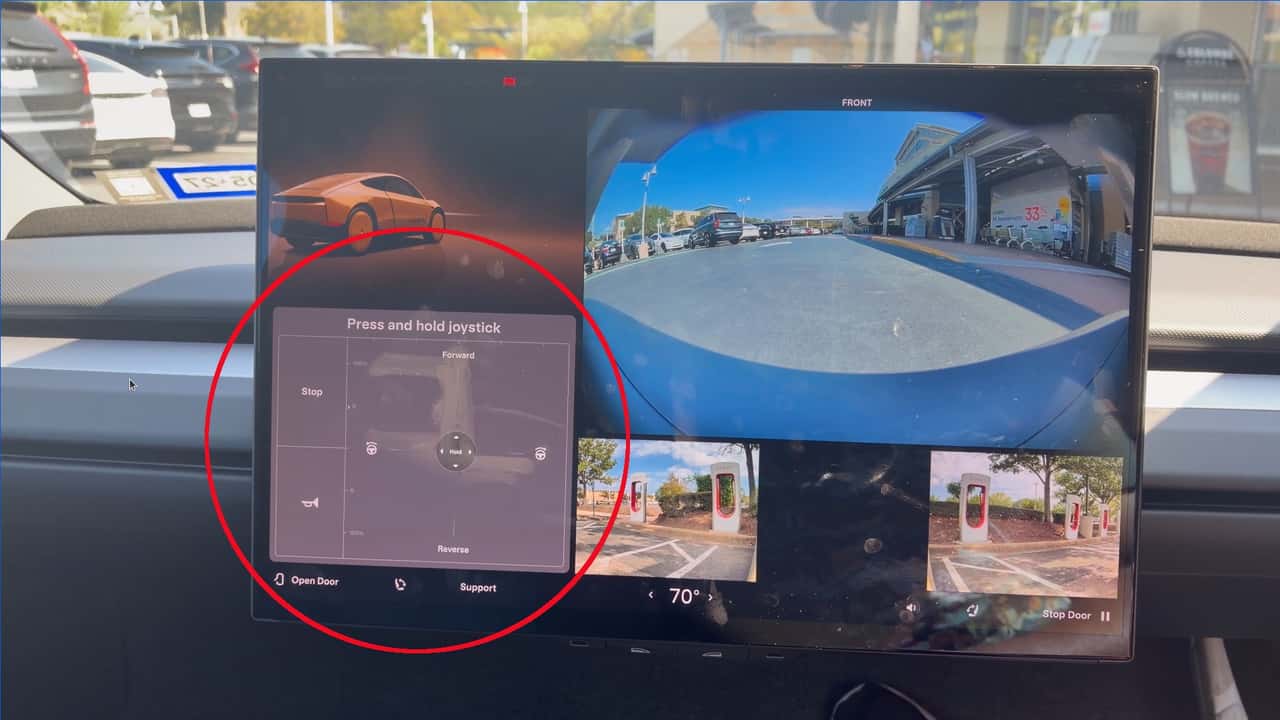
On September 7, a Tesla rider posted video showing the Cybercab’s touchscreen switched into an engineering interface. There it was: a virtual joystick, camera feeds, door controls, and a prompt to call support. The interface was clearly not designed for paying passengers. It was a peek at Tesla’s fallback system.
Here’s what this tells investors: Tesla designed the Cybercab without steering wheel or pedals for regulatory and aesthetic reasons. But the vehicle still needs human controls for testing and edge cases. So Tesla built a hidden interface that allows Tesla service personnel (and apparently riders who stumble into the right menu) to take manual control.
This is engineering pragmatism. It’s not a fundamental flaw. But it undermines the narrative that autonomy is complete.
Consider the regulatory implications: NHTSA is investigating whether the Cybercab meets federal safety standards without manual controls. Now regulators have evidence that Tesla itself doesn’t trust the autonomy enough to eliminate manual controls entirely. They’re just hidden.
For equity investors, this matters because it affects regulatory risk. If NHTSA determines that the Cybercab requires steering wheel retrofits for public road operation, Tesla’s entire production timeline collapses. The company would need to re-engineer vehicles, retrofit existing units, or delay commercial deployment while federal rules are modernized. Each scenario destroys valuation multiples.
The Regulatory Gamble
Tesla’s bet is that NHTSA will either approve the self-certification or fast-track an exemption process. The company is betting that by launching public rides before formal approval, it signals inevitability to regulators.
That’s a high-risk strategy. NHTSA has already opened an audit query (AQ26002). The agency is asking Tesla to document exactly how it self-certified compliance with steering wheel and pedal requirements when the vehicle has neither.
The Trump administration signals pro-innovation intent, but it hasn’t overridden regulatory processes. NHTSA has said it’s working on modernized standards for autonomous vehicles, but no timeline has been announced. Until those rules exist, the old standards remain in force.
Worst case for Tesla shareholders: NHTSA denies the self-certification, demands steering wheel retrofits, and the Cybercab sits in limbo while federal rulemaking plays out over 12-24 months. That’s a $50-100 billion market cap correction, easily.
Mid case: NHTSA approves limited deployment in geofenced areas while rulemaking proceeds. Cybercab reaches maybe 5,000 units by end of 2027, proving the technology works but not at scale. Stock stabilizes but doesn’t rally.
Bull case: NHTSA fast-tracks exemptions, Cybercab deployment expands to five major cities by 2027, utilization rates hit 60 percent or higher, and Tesla credibly demonstrates $250 million-plus annual robotaxi profit. Stock rallies to $600-800 per share.
Comparing the Robotaxi Winners
Tesla is not the only company betting on autonomous vehicles. Waymo (Alphabet) is already operating 4,000+ robotaxis across multiple cities and completing 500,000+ paid rides per week. Amazon’s Zoox is moving toward commercial deployment in multiple markets. Both companies use regulatory exemption processes rather than Tesla’s self-certification approach, which reduces regulatory risk but slows deployment.
For investors, this creates a classic first-mover versus safe-player dilemma. Tesla is pushing forward aggressively, accepting regulatory uncertainty. Waymo and Zoox are moving deliberately, reducing regulatory risk but giving Tesla a potential head start if it wins NHTSA approval.
From a risk-adjusted valuation standpoint, Waymo’s operational proof is more valuable than Tesla’s technological ambition. But Tesla’s cost advantage (under $30,000 per vehicle versus $150,000-plus for modified Waymo vehicles) could matter enormously if both companies achieve similar autonomous capability and deployment scale.
What Investors Should Watch
Three events will determine Tesla’s valuation in the next 12 months:
First: NHTSA Investigation Outcome (Q4 2026). Does the agency approve self-certification or require formal exemption? The difference is weeks versus months in deployment timeline.
Second: Cybercab Utilization Rates (2027). Even if approved, can Tesla achieve 50+ percent utilization across its Austin fleet? Waymo uses extensive fleet analytics; Tesla has published almost no utilization data. Poor utilization destroys robotaxi economics.
Third: Production Scaling (2027-2028). Can Tesla ramp Cybercab production to thousands per quarter? Manufacturing costs and supply chain constraints are brutal for new platforms. This is where many auto programs fail.
The Bottom Line
Tesla’s Cybercab is a genuine engineering achievement. The vehicle exists, it drives itself in geofenced Austin, and riders are using it. That matters. But the hidden joystick and NHTSA investigation reveal that autonomy is still incomplete, regulatory risk is real, and the path from prototype to scaled commercial deployment is years, not quarters.
Equity investors should price in a $200-300 billion valuation cap on robotaxi upside unless and until Tesla demonstrates consistent profitability and deployment scale. That’s still a meaningful business line. But it’s not the $2 trillion transformational scenario that justified the stock’s 7 percent pre-launch jump.
The smartest investors are watching the NHTSA decision and Q1 2027 utilization numbers before adding exposure. Tesla has earned the benefit of the doubt on autonomy. But benefits of doubt don’t last forever.
Questions? Want to talk robotaxi economics?
Reach out to josh@autoautous.com or call 919-389-8290. Auto Auto helps fleet operators and investors evaluate autonomous vehicle deployment strategies.