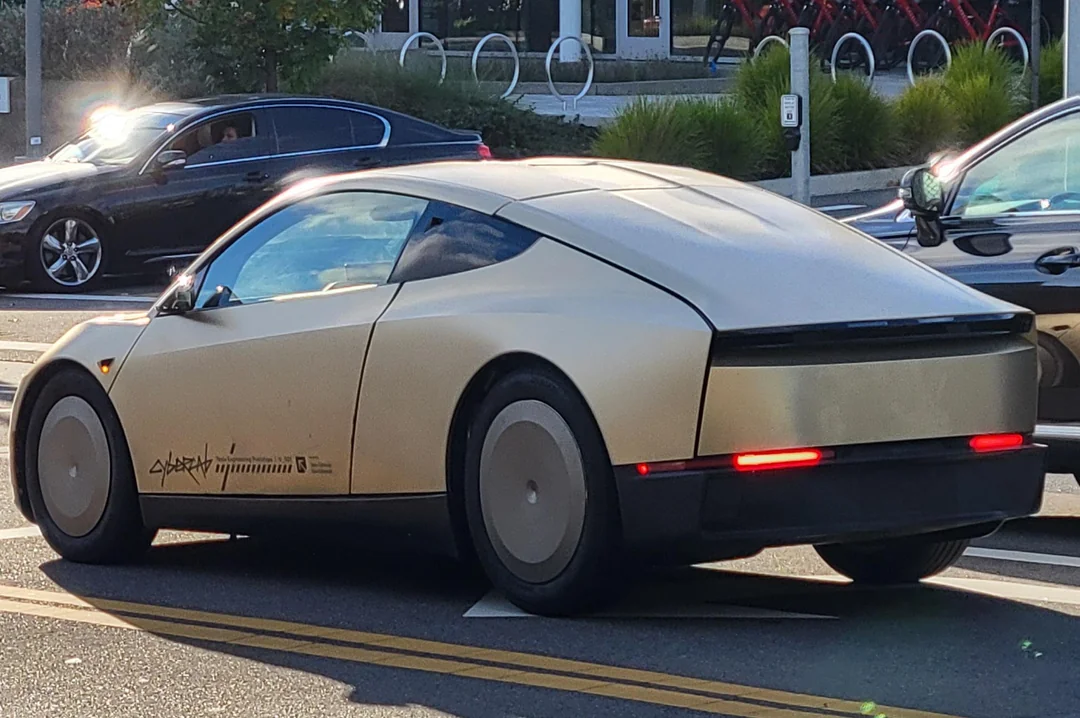
If you’ve been watching Tesla lately, you already know the Cybercab is the biggest reason investors are paying attention. But here’s the question most people are actually asking: Should I just buy Tesla stock and ride the wave — or should I own a Cybercab itself? Both are bets on the same revolution. But they are very different investments. Let’s break down exactly what each one gets you.

Where Tesla Stock Stands Right Now
As of mid-2026, Tesla (TSLA) is trading around $445 per share with a market cap of approximately $1.5 trillion. To put that in context, that’s a price-to-earnings ratio north of 300x — meaning the market isn’t valuing Tesla as a car company at all. It’s valuing it as an AI and robotics platform that happens to also sell cars.
That premium exists almost entirely because of the Cybercab and the Robotaxi network. Strip out the autonomy story and Tesla’s core auto business — which saw its first-ever annual revenue decline in 2025, down 3% to $94.8 billion — would be worth a fraction of today’s price. Goldman Sachs puts a 12-month target at $345. Barclays is at $325. The bears aren’t wrong that the stock is pricing in a future that hasn’t fully arrived yet.
The bulls, however, are loud. Wedbush’s Dan Ives — one of Wall Street’s most vocal Tesla supporters — has a base case of $600 and a bull case of $800. ARK Invest’s model, which assumes robotaxi revenue becomes Tesla’s dominant business, reaches $4,600 per share by 2029. That’s not a typo.
So the honest answer to “can Tesla stock double?” is: maybe. The range of serious analyst targets runs from $125 on the low end to $800 on the high end. That’s not a range — that’s a coin flip dressed up in spreadsheets.
The Bull Case for TSLA Stock
To be fair to the bulls, the Cybercab thesis is genuinely compelling. Here’s what has to go right for the stock to justify its current price — and then some:
- Robotaxi network scales fast. Tesla is already operating fully unsupervised rides in Austin, Dallas, and Houston. Paid miles nearly doubled sequentially in Q1 2026. Wedbush expects the service in 30+ cities by end of 2026.
- Cybercab production ramps without “production hell.” Volume manufacturing began at Gigafactory Texas in April 2026. If Tesla can avoid the delays that plagued the Cybertruck, fleet supply won’t be the bottleneck.
- FSD becomes a recurring revenue machine. Tesla now has 1.28 million active FSD subscriptions — up 51% year-over-year. At $99/month, that’s a software business generating over $1.5 billion annually before the Cybercab fleet even hits the road.
- The TAM is enormous. Goldman Sachs estimates the global robotaxi market at $415 billion by 2035. ARK Invest puts the platform value at $10 trillion. Even capturing 10% of that number transforms Tesla’s earnings profile entirely.
If all of that executes — and Tesla has earned the right to at least be taken seriously here — then yes, TSLA at $600, $800, or even higher is not insane. The Motley Fool recently noted Tesla’s stock has climbed 26% in a single month on Robotaxi optimism alone. The momentum is real.
The Bear Case (And Why It’s Not Crazy Either)
Here’s what the stock price is not telling you:
- Tesla itself said Robotaxi revenue won’t be material in 2026. Elon Musk confirmed on the Q1 2026 earnings call that meaningful Robotaxi contribution is a 2027 story at the earliest. You are paying today for earnings that are 12–18+ months away.
- The company is burning cash aggressively. 2026 capex guidance was raised to over $25 billion — roughly three times what Tesla spent in 2025. Free cash flow will be negative for the remaining three quarters of 2026. The stock is already priced for success while the company is still writing the checks to fund it.
- BYD surpassed Tesla as the global EV leader. Tesla delivered 1.63 million vehicles in 2025 — down 8.5%, the worst sales decline in company history. Chinese competition is real and accelerating.
- A 300x P/E ratio has almost no margin for error. One bad earnings call, one regulatory setback, one high-profile safety incident, and the premium collapses fast. Wells Fargo has a $125 price target. That’s not fringe thinking — it’s what Tesla is worth if the autonomy story stalls.
- You have zero control. When you own TSLA stock, you’re along for whatever ride Elon Musk decides to take — including his time commitments to SpaceX, xAI, and X. Institutional concern about leadership focus is a real, documented risk in analyst reports.

Now Let’s Talk About Owning the Cybercab Itself
Here’s where the comparison gets interesting. When you own a Cybercab through a management company like Auto Auto, your return doesn’t depend on what 40 Wall Street analysts think about Tesla’s P/E ratio next quarter. It depends on one thing: how many miles your car drives and at what rate.
As we broke down in our first post, the numbers on a single vehicle look like this:
| Metric | Cybercab Ownership | TSLA Stock (~$30K invested) |
|---|---|---|
| Initial Investment | $30,000 | ~67 shares of TSLA at $445 |
| Monthly Cash Flow | $1,650 net profit | $0 (no dividend) |
| Annual Return (base case) | 66% | -10% to +80% (analyst range) |
| Breakeven | ~18 months | Unknown — depends on stock price |
| Downside Risk | Vehicle still has resale value; ongoing cash flow | Stock could drop 50%+ (bears: $125–$180) |
| You Control It | Yes — physical asset you own outright | No — subject to market sentiment, Musk news cycles |
| 7-Year ROI | 462% | Anywhere from -72% to +900% (genuinely uncertain) |
The key difference is predictability. Stock returns are determined by millions of investors reacting to quarterly earnings, news cycles, regulatory decisions, and Elon Musk’s posts on X. Cybercab returns are determined by your local ride demand, miles driven, and operating efficiency. One of those you can model. The other you cannot.
Can Tesla Stock Actually Double From Here?
Let’s be direct: it’s possible, but it’s not probable in the near term. Here’s why.
For TSLA to reach $900 (roughly 2x from $445), Tesla would need a market cap approaching $3 trillion. That would make it larger than Apple. To justify that valuation on fundamentals, Robotaxi would need to be generating tens of billions in high-margin recurring revenue — something Tesla’s own management says won’t be material until 2027 at the earliest.
Could it happen? ARK Invest’s model says yes — and then some. But ARK’s $4,600 target requires assumptions so optimistic that even Tesla bulls acknowledge the range of outcomes is extreme. The Wall Street consensus 12-month target sits at roughly $398–$406. That implies almost no upside from today’s price on average, with tremendous variance on either side.
Contrast that with the Cybercab: the asset already exists, production is already running, and Austin is already proving the revenue model works at $1.40/mile with real riders paying real money. The Cybercab’s 66% annual ROI isn’t contingent on a $3 trillion market cap being assigned to Tesla by investors who may or may not believe the story next quarter.

The Hidden Advantage of Owning the Asset, Not the Stock
Here’s something most investors don’t consider: when you own a Cybercab, you are also positioned to benefit from Tesla’s success — just without the stock market volatility attached.
If Tesla’s Robotaxi network expands aggressively, your vehicle earns more. If Tesla raises fares (which they already did in Austin as demand grew), your revenue goes up. If Tesla’s brand drives massive rider adoption, your utilization rate improves. You capture the upside of the Cybercab story in a direct, tangible way — through cash flow — rather than hoping the stock market agrees with you on a Tuesday morning.
And unlike stock, your Cybercab doesn’t go to zero if the market has a bad quarter. It still has physical resale value. It still generates income every day it operates. A panic selloff doesn’t affect your monthly deposit.
So Which Is the Better Investment?
The honest answer depends on what you’re optimizing for:
| If you want… | Consider… |
|---|---|
| Predictable monthly cash flow | Cybercab ownership |
| Maximum upside if Tesla’s AI vision fully executes | TSLA stock |
| Lower volatility and downside protection | Cybercab ownership |
| Liquidity (ability to sell quickly) | TSLA stock |
| Passive income that isn’t tied to Elon’s Twitter activity | Cybercab ownership |
| A way to invest $500 instead of $30,000 | TSLA stock (fractional shares) |
The smartest investors we talk to are doing both — holding some TSLA for long-term upside exposure while deploying capital into Cybercab ownership for immediate, reliable cash flow. But if you can only choose one and your goal is passive income with a clear return model, the Cybercab wins on almost every metric that matters for everyday investors.
Stock speculation is hoping someone else will pay more for your shares later. Cybercab ownership is building a machine that pays you every single day — regardless of what happens on Wall Street.
The Bottom Line
Tesla stock could double. Wedbush thinks so. ARK thinks it could go up 10x. But with a 300x P/E ratio, $25 billion in capex burning through 2026, and management saying Robotaxi revenue won’t be material until 2027, you are making a speculative bet on a future that hasn’t arrived yet — and paying a very high price for that bet.
Owning a Cybercab through a professional management company like Auto Auto gives you the same underlying exposure to the Robotaxi revolution — but with real cash flow, a physical asset, and a return that doesn’t require a $3 trillion market cap to materialize. The 66% annual ROI and 18-month breakeven aren’t projections built on hope. They’re built on real Austin pricing, real operating benchmarks, and a vehicle already rolling off the production line.
The Cybercab revolution is happening. The only question is whether you participate as a spectator buying stock — or as an owner collecting the revenue directly.
Become a Cybercab Owner with Auto Auto →
This post is for informational purposes only and does not constitute financial or investment advice. Stock price targets and projections referenced are from third-party analysts and are not guaranteed. Consult a licensed financial advisor before making any investment decisions.